Siwin-A210
Siwin
Siwin-A210
3179-76-8
| Quantity: | |
|---|---|
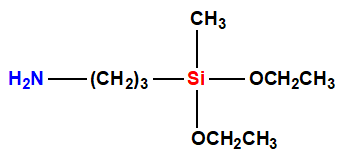
3-Aminopropylmethyldiethoxysilane is a difunctional amino silane that contains a primary amine group and a diethoxymethylsilyl group. The methyl substitution on the silicon atom distinguishes this product from trialkoxy amino silanes, imparting increased hydrophobicity and flexibility to the cured siloxane network. This structural difference makes the silane particularly suitable for applications where a balance of adhesion promotion and polymer flexibility is required.
The chemical formula of 3-aminopropylmethyldiethoxysilane is C₈H₂₁NO₂Si. The molecule consists of a propyl chain with an amino group (-NH₂) at one end and a methyl-diethoxysilyl group at the other. The amino group is highly reactive toward epoxy, phenolic, isocyanate, and other functional groups in organic polymers. The diethoxymethylsilyl group hydrolyzes in the presence of moisture to form silanol groups, which condense with hydroxyl groups on inorganic surfaces such as glass, minerals, and metal oxides. The methyl group on silicon reduces the crosslink density of the siloxane network compared to trialkoxy silanes, resulting in a more flexible bond line.
The following equivalent product table is preserved from the source page without modification:
Momentive | Dowcorning | ShinEtsu | Evonik | Wacker |
|---|---|---|---|---|
A-2100 | Z-6015 | KBE-902 | DY 1505 | / |
The following physical properties table is preserved from the source page with the density unit corrected from g/m³ to g/cm³:
Parameter | Value |
|---|---|
Product No. | Siwin-A210 |
Chemical Name | 3-Aminopropylmethyldiethoxysilane |
CAS NO. | 3179-76-8 |
EINECS NO. | 221-660-8 |
Formula | C8H21NO2Si |
Appearance | Colorless Transparent Liquid |
Density (ρ20°C, g/cm³) | 0.9110 ± 0.0050 |
Refractive Index (n 25°C) | 1.4240 ± 0.0050 |
Purity (by GC, %) | 96% |
Additional reference parameters:
Parameter | Value |
|---|---|
Molecular Weight | 191.34 g/mol |
Boiling Point | 85-88°C |
Flash Point | 68°C |
Melting Point | <-20°C |
3-Aminopropylmethyldiethoxysilane is used as a functional additive in a variety of industrial applications where it modifies the interface between organic polymers and inorganic materials.
In cold-curing phenolic and furan foundry resins, this silane serves as an additive that improves the flexural strength of sand-resin composites. The amino group reacts with the resin matrix, while the silane groups bond to the sand surface, creating a stronger and more durable sand mold. Formulations incorporating this silane also exhibit extended shelf life compared to systems using trialkoxy amino silanes, which is attributed to the reduced reactivity of the diethoxymethylsilyl group.
As a component in glass fiber sizing formulations, 3-aminopropylmethyldiethoxysilane improves the bond between glass fibers and polymer matrices. The silane deposits on the fiber surface during the sizing process and provides chemical coupling sites for the resin system used in composite manufacturing. This results in composite laminates with improved interlaminar shear strength and resistance to moisture degradation.
In mineral-filled polymer composites, this silane is used for the pretreatment of fillers and pigments, or added directly as a formulation additive. It improves the dispersion of mineral fillers in the polymer matrix by modifying the filler surface to be more compatible with the organic phase. Improved filler dispersion leads to better processing rheology, reduced compound viscosity, and the ability to achieve higher filler loadings while maintaining mechanical performance.
3-Aminopropylmethyldiethoxysilane serves as a building block for the synthesis of amino-functional silicone fluids and resins. The amino group can undergo further chemical reactions to introduce additional functionalities, while the diethoxymethylsilyl group participates in siloxane bond formation during polymerization.
Incorporation of this amino silane into filled composite systems can lead to measurable improvements in mechanical properties, including flexural strength, tensile strength, impact strength, and modulus of elasticity. The magnitude of improvement depends on the filler type, loading level, polymer matrix, and silane dosage.
Silane-treated fillers exhibit better dispersion in polymer matrices, which translates to improved processing characteristics. These include reduced compound viscosity, more Newtonian rheological behavior, and the ability to achieve higher degrees of filling without sacrificing processability. Improved dispersion also contributes to more uniform electrical properties, such as dielectric constant and volume resistivity, in filled systems.
Siwin-A210 is available in two standard packaging configurations. The 210L iron drum contains 200 kg of product, while the 1000L IBC container holds 1000 kg. Both packaging options are designed for safe transport and storage of moisture-sensitive silane products.
The product should be stored in a cool, dry area with the drum or container tightly sealed to prevent moisture ingress. Under proper storage conditions, the shelf life is 12 months from the date of manufacture. As with all amino silanes, handling should be performed in well-ventilated areas with appropriate personal protective equipment, including chemical-resistant gloves and eye protection.
3-Aminopropylmethyldiethoxysilane has a methyl group on the silicon atom in place of one ethoxy group. This reduces the number of hydrolyzable groups from three to two, resulting in a lower crosslink density in the cured siloxane network. The practical effect is a more flexible bond line, better hydrophobicity, and longer shelf life in certain resin systems compared to triethoxy amino silanes.
This amino silane is compatible with phenolic resins, furan resins, epoxy systems, polyurethanes, and other polymers that contain functional groups reactive toward primary amines. It is also used in silicone formulations as a functional building block. The specific compatibility should be verified through laboratory testing for each application.
In cold-curing foundry resin systems, typical addition levels range from 0.2% to 1.0% by weight of the resin. The exact dosage depends on the resin type, sand composition, desired strength improvement, and specific process conditions. Formulation trials are recommended to determine the optimal level for each application.
Yes, 3-aminopropylmethyldiethoxysilane can be applied as a surface primer on glass and metal substrates to improve subsequent coating or adhesive bonding. The silane is typically diluted in a solvent or water-based solution and applied to the clean substrate surface, where it forms a thin siloxane layer after hydrolysis and condensation.
Small spills should be absorbed with inert material such as sand or vermiculite and placed in a suitable waste container for disposal. Avoid contact with water, as the silane will hydrolyze. The spill area should be ventilated and personnel should wear appropriate protective equipment. Refer to the Safety Data Sheet for detailed spill response and disposal instructions.